
A crew shows up ready to start, and the permit is still sitting untouched in a municipal review queue. Finding out why means logging into a different portal for every jurisdiction the company works in, then calling the offices that don’t have a portal at all. That gap between what’s happening on the jobsite and what’s happening on paper costs trade contractors real hours every week.
Building permit software has moved past basic status tracking into AI-powered platforms that handle document processing, compliance checks, and inspection scheduling on their own, closing that gap instead of just tracking it.
The Permit Bottleneck Trade Contractors Face
Permit delays directly threaten a trade contractor’s schedule and cash flow. Every day an approval sits in queue holds up the follow-on work behind it, extends carrying costs on equipment and labor, and pushes back the point where a job actually generates revenue.
Manual permit management makes the problem worse. Tracking status across multiple jobs through spreadsheets and phone calls introduces errors, missed renewals, and compliance gaps that don’t surface until an inspection fails or a permit lapses.
The administrative load doesn’t scale in a straight line with job volume. It scales faster. Doubling the number of active permits more than doubles the number of status calls, follow-up emails, and renewal dates a contractor has to track by hand, because each job adds its own jurisdiction, timeline, and point of contact.
Municipal permit variations delay and compound the problem further. Every jurisdiction sets its own submission requirements, review timelines, and inspection scheduling process, so contractors working across multiple markets carry that complexity in disconnected systems that don’t talk to each other.
The bottleneck is structural for any contractor managing real volume. What comes next is the more useful question.
What Building Permit Software Does
Building permit software centralizes permit applications, tracks approval status across active jobs, manages required documentation, and coordinates inspection scheduling in one system.
For trade contractors, the core value is visibility: knowing where every permit stands across every active job without making phone calls or opening multiple spreadsheets to piece the picture together.
Permit management software extends that same functionality to the portfolio level, monitoring permit status, expiration dates, and inspection outcomes across an entire job backlog rather than one project at a time.
Manual vs. Software Comparison
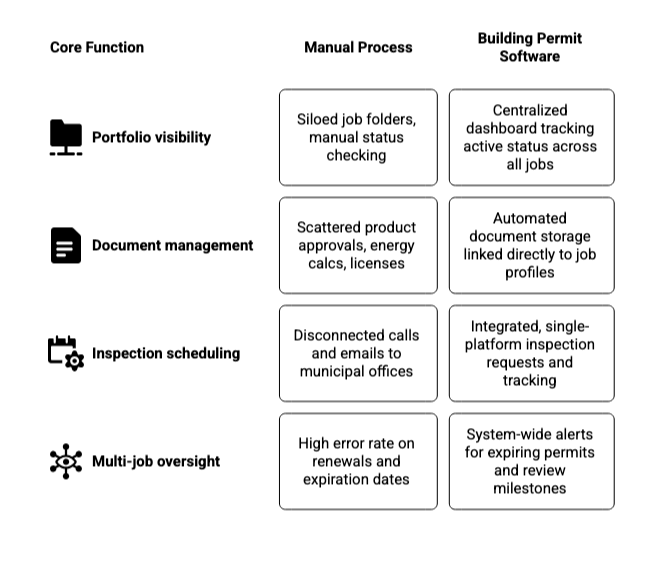
Centralizing permit applications and documentation solves the manual tracking problem on its own. Adding AI to that foundation is what changes what the software can actually do for a contractor.
How AI Is Changing Building Permit Software
AI in construction is already changing how trade professionals handle administrative work, and permitting is where that shift shows up first.
Submission assembly comes first. AI automatically populates required application fields using historical job data and flags missing attachments before a contractor submits, cutting preparation time and reducing incomplete filings.
Pre-review compliance checking comes next. Algorithms cross-reference application data against local code requirements in real time, catching errors before they reach the building department and reducing rejection rates.
Predictive status tracking closes the loop. The system analyzes historical municipal review data to flag stalled applications before they miss a project deadline, giving contractors time to follow up before delays compound into bigger schedule problems.
A 2025 survey from the National Fire Protection Association found that 95% of trade professionals believe AI has a purpose in at least some part of their day-to-day job functions. Among those who had already implemented digital tools, 64% reported improved workflows and collaboration.
AI in construction is not replacing physical trade work. It is handling the administrative layer that surrounds trade work, freeing contractors and staff to focus on the job instead of the paperwork behind it.
Will AI Replace Construction Workers?
The concern is a real one and worth addressing directly rather than waving it off. The same NFPA survey found that 25% of trade professionals remain skeptical of AI’s purpose in their field.
In the skilled trades, the answer is specific. AI is not suited to replace physical trade work. Electrical installation, HVAC service, roofing, and plumbing require dexterity, real-time judgment, and hands-on skill that software cannot replicate.
What AI replaces is administrative work: form preparation, status tracking, document management, inspection coordination. These are tasks that consume contractor time without producing trade output. Moving that work to software frees trade professionals to spend more of their time on the work that actually requires them.
For contractors specifically, that shift shows up as fewer hours lost to paperwork and more of the crew’s day spent on the job itself.
What Trade Contractors Need in AI-Powered Building Permit Software
Not all building permit software is built for trade contractors. The municipal platforms that dominate the category are designed for government users processing applications, not for a contractor managing permit volume across multiple markets and trades.
Portfolio-level tracking matters most. A trade contractor running 30 to 50 active permits needs visibility across all of them at once. The platform should surface permit status, expiration dates, and upcoming inspection windows at a portfolio level without requiring manual entry per job.
Document automation follows close behind. Permit applications require consistent documentation across jurisdictions, so the platform should store, organize, and auto-populate required documents by job type and market, cutting preparation time on each new application.
Inspection scheduling integration ties permit status to permit closeout. The platform should coordinate inspection requests and track outcomes without forcing contractors to manage that separately from the permit itself.
Multi-market capability rounds it out. Contractors operating across Florida, Texas, Georgia, or Tennessee face different municipal requirements in each jurisdiction, and the platform needs to handle that variation without forcing a separate process for every market.
Inspected’s AI permit and virtual inspection platform, Permit Hub, is built specifically for trade contractors managing permit volume across multiple markets. Real-time permit tracking, document management, and inspection scheduling in one platform give contractors the visibility and control that spreadsheet-based management can’t provide.
Put AI-Powered Building Permit Software to Work
The permit process does not slow down because contractors are bad at their jobs. It slows down because manual tracking, disconnected scheduling, and jurisdictional variation compound at scale. AI-powered permitting services address all three. Contractors who make that shift now spend less time chasing approvals and more time closing jobs.
See Permit Hub in action and schedule a demo to learn more about how AI-powered building permit software fits into daily operations.
Frequently Asked Questions About Building Permit Software
What Is Building Permit Software?
At the simplest level, it’s a single system standing in for a stack of spreadsheets and a running list of phone numbers. One dashboard shows where every permit stands, what documentation is attached to it, and when the next inspection is due, instead of a contractor reconstructing that picture job by job.
How Does AI Improve Permit Management Software for Contractors?
Three ways specifically. It fills out application fields from a contractor’s own past submissions instead of starting from a blank form. It checks a submission against local code before a reviewer ever sees it, catching the kind of error that normally comes back as a rejection. And it watches how long a municipality typically takes to respond, so a contractor knows a permit is running late before the deadline actually passes.
Will AI Replace Construction Workers?
No, and the two categories of work aren’t in competition. Wiring a panel, sizing a duct, or setting a roof still comes down to a person making a judgment call on-site, something software has no path to replicating. What’s changed is who handles the paperwork trailing behind that work, freeing the people who do the trade to spend less time on it.
What Is the Difference Between Building Permit Software and Permit Management Software?
Scale is the real distinction. Software built for a single application handles one job well. Software built for portfolio management is built for the contractor running thirty or fifty of them at once, where the harder problem isn’t any one permit; it’s keeping track of all of them at the same time.
How Does AI-Powered Permitting Reduce Project Delays?
Delays tend to trace back to one of three habits: a submission that was missing something the first time, a follow-up that never got made, or an inspection that had to be scheduled separately from everything else. Closing those gaps is most of what determines whether a permit moves on schedule or sits in a queue.