
The labor pool contractors hire from is changing. A growing share of young workers now enter apprenticeships and vocational programs instead of four-year degree programs, and that shift is showing up in enrollment numbers, hiring data, and jobsite demographics; at the same time, contractors are struggling to fill electrician, HVAC, and plumbing positions. Contractors who understand why this shift is happening, and what these workers expect from an employer, are better positioned to recruit and retain talent going into the next decade.
The Toolbelt Generation Is Already in the Workforce
Gen Z is the youngest generation in the workforce, and members born between 1997 and 2012 now make up a growing share of new hires across the skilled trades. This is not a forecast. It shows up today in enrollment data, hiring data, and the composition of crews on job sites.
Construction trades, engineering technology, and mechanical and repair programs outgrew nearly every other major field of study from 2024 to 2025, according to the National Student Clearinghouse Research Center. Vocational-focused public two-year institutions posted an 11.7% enrollment increase for the third consecutive year, and enrollment at trade-focused institutions has climbed almost 20% since spring 2020 to 871,000 students, now 19.4% of all public two-year enrollment. Two-year institutions also saw an 8.3% year-over-year increase in engineering technologies and technicians programs.
Community college enrollment overall grew 3.0% in fall 2025, and vocational programs drove a disproportionate share of that growth.
The term “toolbelt generation” emerged from this trend and has appeared in coverage from NPR, the Wall Street Journal, and major broadcast outlets to describe the pattern.
The shift is real and measurable. The next question is why it’s happening.
Why Young Workers Are Skipping College for Trades
The decision to skip college for trades starts with a financial calculation. A four-year degree accumulates tuition debt before a graduate earns a dollar. A trade apprenticeship pays a wage from day one and increases that wage as the apprentice gains skill, with no loan balance attached.
A large student debt balance at graduation restricts financial mobility for years and shapes career decisions long after the degree is earned, from where a graduate can afford to live to whether they can take a lower-paying first job in their field.
Automation concerns factor into the decision too. Many workers entering the labor force see desk-based, white-collar roles as more exposed to AI automation than physical, judgment-intensive trade work, and that perception is shifting career intent among Gen Z workers weighing their options.
The wage math backs up the choice for the trades contractors’ clients depend on. The median annual wage for electricians was $63,190 in May 2025; plumbers, pipefitters, and steamfitters earned a median of $63,800, and HVAC-R mechanics and installers earned $61,010, all above the median annual wage of $50,980 for all U.S. occupations, according to the Bureau of Labor Statistics. Apprenticeship programs pair that wage with a direct, employer-sponsored path to a credential and a job, removing the uncertainty of a degree that may not translate into steady employment.
A June 2026 Chalkbeat analysis pushed back on the six-figure trades narrative, finding that headline salaries are outliers and that many non-college jobs pay below the national median. That analysis covers non-college occupations broadly, from retail to logistics to construction labor. The trades contractors in this industry- electricians, HVAC technicians, and plumbers- rank among the better-compensated non-college career paths by the same BLS wage data. The wage argument holds up for these specific trades even where it doesn’t hold up industry-wide.
College vs. Trades Comparison
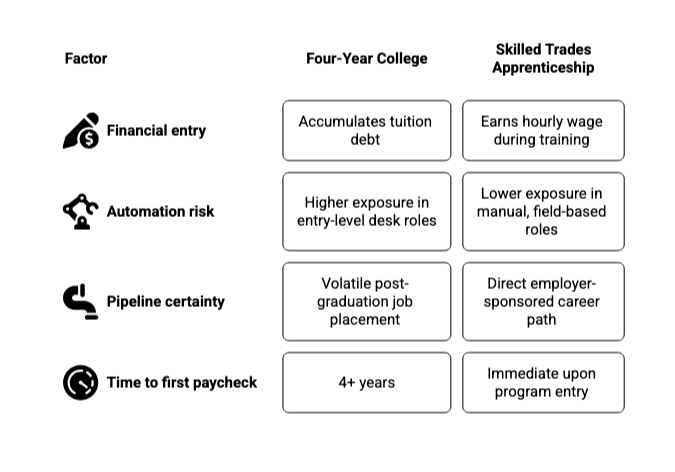
These economics explain why workers are choosing the trades. What they’re stepping into is a shortage that has been building for years, detailed in construction industry trends that contractors are already navigating.
A Skilled Trades Shortage Decades in the Making
The skilled trades shortage isn’t a cyclical dip. Experienced workers have been retiring out of the trades faster than new workers enter the pipeline for years, and the Bureau of Labor Statistics numbers put the scale of that gap in perspective for the trades contractors depend on most.
Trades Shortage Data (BLS 2025-2035 Projections)
Electricians have about 72,700 annual openings projected, with employment growth of 9% from 2025 to 2035, faster than the average for all occupations. Growth is driven by residential and commercial construction, renewable energy installations, and the buildout of data center and EV infrastructure.
HVAC-R mechanics and installers are projected to grow 11% from 2025 to 2035, well above the average for all occupations, with about 40,600 annual openings driven by aging commercial and residential climate-control systems and continued commercial construction.
Plumbers, pipefitters, and steamfitters have approximately 42,000 annual openings projected, with employment growth of 7% from 2025 to 2035.
Most of these openings come from replacement, not new demand. Workers are retiring out of the trades faster than the pipeline replaces them. Gen Z entering at growing rates narrows that gap but doesn’t close it in the near term. For contractors, that means longer hiring timelines, upward pressure on wages, and more competition for the same pool of qualified workers.
The HVAC industry trends shaping demand on the technical side compound the same labor math on the hiring side. The workers entering the trades right now have options, and understanding those options is the difference between recruiting successfully and losing candidates to a competitor.
New Collar Jobs Are Redefining What Trade Work Looks Like
The trades this generation is entering aren’t the same trades their grandparents or parents did 30 years ago. Digital tools, app-based workflows, and real-time platforms are built into daily work, and workers who arrive expecting them are well suited to what the job now requires.
“New collar jobs” describes roles that combine hands-on technical skill with digital fluency. In the trades, that means electricians, HVAC technicians, roofers, and plumbers who use digital permit applications, virtual inspection platforms, real-time compliance documentation, and app-based scheduling as part of a normal day, not as an occasional add-on.
Gen Z workers grew up with smartphones and software. They aren’t entering a low-tech field expecting to adapt down. Their digital fluency is an asset on a jobsite that runs on apps and platforms rather than paper forms.
Technology adoption in the trades isn’t optional anymore. Municipalities across Florida and Texas have moved permit applications and inspection scheduling onto digital platforms, and contractors whose own operations match that shift close jobs faster than contractors still working from spreadsheets and phone calls.
The gap shows up in hiring too, and runs both directions. Gen Z workers weigh the tools an employer uses when they choose where to work. A contractor running permits on spreadsheets and waiting weeks for a municipal inspector is a less attractive employer to a worker who expects modern systems on day one.
Inspected’s permit and virtual inspection platform gives contractors that infrastructure directly: real-time scheduling, permit tracking, and documentation in one place, with faster approvals and less administrative drag. That kind of operational setup is exactly what appeals to workers who expect their employer to run efficiently.
The new collar jobs concept describes the environment Gen Z workers are stepping into: new technology growth, career priority shifts, and the industry evolving with it.
What the Toolbelt Generation Means for Contractors
The toolbelt generation entering the workforce changes two things for contractors: who is available to hire, and what those workers expect once they’re hired.
Younger trade workers bring tech fluency that can expedite permit documentation, compliance records, and jobsite communication, but that value only shows up if the contractor’s systems can support it. Contractors still running on paper forms and phone calls get little of that value. The ones who’ve moved to a digital inspection platform let their tech-fluent workers operate with minimal oversight.
BLS data shows trade wages for electrical, HVAC, and plumbing work compete well against entry-level white-collar roles, and that advantage should hold given sustained demand through the 2025-2035 projection window. Contractors don’t need to dramatically overpay to compete for this generation. They need operational environments that function like modern workplaces.
Modernizing trade operations, meaning digital permits, virtual inspections, and app-based tools, is becoming a hiring differentiator rather than a nice-to-have. Workers who choose trades over desk jobs aren’t choosing a low-tech environment by default. They expect tech parity with the office jobs they passed up.
Build a New Collar Trade Business
The toolbelt generation isn’t waiting for the trades to catch up. Contractors who modernize tools and workflows now build a more efficient operation today and the kind of operation the next generation of trade workers will choose tomorrow.
Contact the Inspected Team to see how an AI-powered permitting and inspection platform fits into your hiring strategy.
Frequently Asked Questions About Skipping College for Trades
What Is the Toolbelt Generation?
The toolbelt generation refers to members of Gen Z, those born between 1997 and 2012, who are choosing skilled trades careers over four-year college programs. The term reflects a measurable shift in how the youngest generation approaches career decisions, driven by rising tuition costs, competitive trade wages, and concerns about AI displacing desk-based roles.
Why Are Young Workers Choosing to Skip College for Trades?
The financial calculation has shifted. Apprenticeship programs let workers earn income during training, avoiding the student loan debt that comes with a four-year degree. Trade wages for electrical, HVAC, and plumbing work compete with entry-level white-collar roles. The hands-on nature of trade work also makes it more resistant to automation than many desk-based entry-level positions.
What Are New Collar Jobs?
New collar jobs combine hands-on technical skill with digital fluency. In the trades, this describes electricians, HVAC technicians, and other tradespeople who use digital permit platforms, virtual inspection tools, and app-based documentation as a standard part of their workflow, not as a supplement to it.
Which Skilled Trades Have the Most Job Openings?
According to the Bureau of Labor Statistics, electricians lead with approximately 72,700 projected annual openings and 9% employment growth from 2025 to 2035. Plumbers, pipefitters, and steamfitters account for approximately 42,000 annual openings with 7% projected growth over the same period. HVAC-R mechanics and installers are projected to grow 11%, well above the average for all occupations.
Will the Skilled Trades Shortage Improve As Gen Z Enters the Workforce?
Gen Z entering trades at growing rates is a positive development, but the shortage is structural. The Bureau of Labor Statistics projects tens of thousands of annual openings across the major skilled trades through 2035, primarily driven by retirements rather than new demand. The incoming generation will narrow the gap, but the volume of openings means the shortage will remain a real constraint for contractors through the decade.