
Solar installation demand across Florida, Texas, Georgia, and Tennessee peaks in summer. More installs mean more permit applications hitting building departments at the same time, more competition for inspection slots, and less margin for documentation errors. Contractors who treat permitting and solar panel inspection services as part of the installation schedule tend to close more jobs on time during the busiest stretch of the year.
Solar inspections sit at the end of the installation timeline. Passing one clears the way to Permission to Operate (PTO) from the utility, which activates the system. Any delay between completed install and passed inspection is a delay in closeout, and during the summer, those delays build up across an entire active job pipeline.
Why Solar Inspections and Installation Demand Peaks in Summer
The summer demand spike is not a single cause. Longer daylight hours, utility bills soaring during air conditioning season, and homeowners locking in tax incentives before year-end all boost residential solar installation volume up from June through August. Commercial solar panel installations follow financing and construction cycles that don’t track weather, but those projects land on the same building department calendars and compete for the same inspection capacity.
For solar panel installation contractors managing multiple active jobs, the practical problem is that building departments in the states that Inspected serves are processing large numbers of permits at the same time inspection queues are at their longest. A permit submitted in late July in Georgia sits in a longer queue than the same permit submitted in March. A failed inspection in August takes longer to reschedule than one in February.
Solar panel inspection services cover the post-installation verification step, confirming that the installed system meets the electrical and structural requirements set by the Authority Having Jurisdiction (AHJ) in the approved permit. That inspection is the final gate before the AHJ signs off and the utility issues Permission to Operate. Until it passes, the installed system must remain shut down, net metering cannot be activated, and the final payment milestone sits uncollected. A failed inspection doesn’t just delay one job; it reorganizes the schedule for every project behind it.
The permitting picture changes once project type enters the conversation. From the start, residential and commercial solar installations move through different processes.
Residential vs. Commercial Solar Panel Installation: What Changes for Permitting
Residential solar panel installation and commercial solar panel installation run on separate permitting tracks. Contractors who do both need to treat them as distinct workflows, not variations of the same process.
Residential Permitting
Residential permitting follows a more standardized path in most jurisdictions. The documentation package is largely predictable from job to job: structural letter, electrical one-line diagram, panel layout plan, and equipment specification sheets. The main variable is the jurisdiction’s review timeline, which depends on staff capacity and local process.
In SolarAPP+ participating jurisdictions, that timeline compresses significantly. Developed by the National Renewable Energy Laboratory (NREL) and funded by the U.S. Department of Energy Solar Energy Technologies Office (SETO), SolarAPP+ is a web-based platform that automates permit review for residential rooftop solar PV systems, allowing code-compliant applications to receive permits instantly rather than waiting in a manual review queue. The platform is built for residential PV and solar-plus-storage systems. Commercial installations are outside its scope and must go through standard review.
Commercial Solar Panel Installation
Commercial solar panel installation adds layers that residential work does not. Engineering stamps are standard. Plan review typically runs through multiple departments, building, electrical, and sometimes fire and utility, before a permit can be issued. Most jurisdictions classify everything outside of single-family detached homes and duplexes as commercial, regardless of scale, which means a townhouse complex or small retail roof carries commercial documentation requirements even if the array size is modest. Contractors moving from residential to commercial construction projects in a new jurisdiction should confirm classification rules before submitting.
Residential vs. Commercial Solar Panel Installation: Permitting Requirements
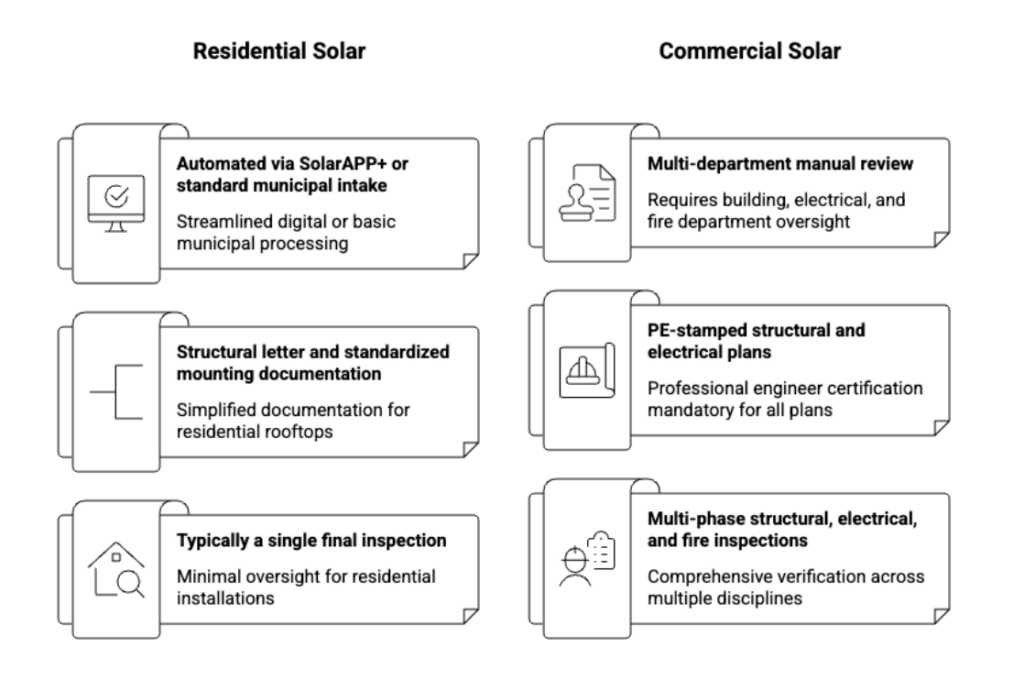
Knowing which track applies is step one. The jurisdiction determines what that track requires, and requirements vary considerably across Florida, Texas, Georgia, and Tennessee.
Solar Panel Installation Permits Across Florida, Texas, Georgia, and Tennessee
Permitting authority for solar panel installation permits sits at the city or county level in all four states. Requirements shift by jurisdiction, and what clears quickly in one municipality can require additional documentation across the county line.
Texas: The Houston Permitting Center solar panel permit requires both a building permit and a separate electrical permit for solar PV installations. Applications are submitted electronically through the iPermits portal, with plans reviewed via ProjectDox.
Houston adopted SolarAPP+ in July 2024 for qualifying residential systems, which gives registered contractors a faster path through residential permits. Projects in windborne debris regions are excluded from SolarAPP+ and must go through traditional plan review. Jurisdictions outside city limits follow their own municipal requirements.
Georgia: In DeKalb County, a building permit is required for all solar energy system installations, both residential and commercial. A separate electrical permit is issued after building approval.
Commercial projects also require a Photovoltaic Tree Affidavit if trees are removed to clear the array footprint. Contractors working inside one of DeKalb’s incorporated cities, such as Decatur, Brookhaven, or Dunwoody, begin with that city’s permitting office rather than the county.
Tennessee: Metro Nashville runs solar permitting through a dedicated Electrical Photovoltaic Permit process. Contractors apply using the CAEP permit subtype through Metro Nashville’s Solar Panel Photovoltaic Permits page.
Residential permit fees start at $75. A separate interconnection approval from Nashville Electric Service (NES) is also required before a system can connect to the grid. Contractors must hold a Tennessee state license and be registered with Metro Codes and Building Safety before submitting.
Florida: HB 683’s permitting reforms, private provider authorization, five-day review timelines for single-trade permits, and virtual inspection rules are covered in the Florida solar permit approvals guide.
Contractors active in Florida should treat that article as the jurisdiction-specific reference rather than rely on this one.
The timing of both relative to the installation date is where scheduling decisions either protect or damage job margins.
When Is the Best Time to Install Solar Panels?
The solutions that solar panel installation contractors need are different from those of most homeowners. Weather and daylight are not the binding constraints on a summer solar installation. The permit timeline and inspection capacity are.
Summer is simultaneously the highest-demand season and the period when building departments in Florida, Texas, Georgia, and Tennessee are most stretched. Permit applications submitted in June and July sit in longer queues than those submitted in February or March. Inspection slots fill faster. Rescheduling after a failed inspection takes longer. None of that stops experienced contractors from running high volume in summer, but it does require that permit applications go in before installation is scheduled, not after.
In SolarAPP+-participating jurisdictions, the question of when is the best time to install solar panels becomes less about municipal capacity and more about crew availability. Eligible residential systems receive permits instantly, which removes the biggest pre-installation delay regardless of season. Contractors operating in jurisdictions without automated review need to factor manual review windows into the job timeline and build the inspection request into the plan before installation begins.
The contractors who manage summer volume best approach each job in the same order: submit the permit application early, confirm the inspection window before committing to an installation date, and have all documentation assembled at the time of submission rather than after a permit is issued.
Finding Solar Panel Installation Contractors and Installation Services
The licensing and registration requirements for solar panel installation contractors vary by state and sometimes by county. In Tennessee, installation must be performed by a contractor licensed and bonded with the State of Tennessee Department of Commerce and Insurance and registered with Metro Codes and Building Safety. In Texas, contractor registration with the Houston Permitting Center is required before permit applications can be submitted. In Georgia, contractors working in DeKalb County must hold a state license and be registered with DeKalb Development Services.
For property owners and commercial project managers evaluating solar panel installation services, the closeout step is worth asking about specifically: who handles the inspection, and how fast can it be scheduled after installation is complete? Contractors who have a private provider already registered in the applicable jurisdiction can schedule solar inspections on installation day rather than waiting for a municipal queue to open.
Inspected is a licensed private provider operating across Florida, Texas, Georgia, and Tennessee. Solar inspection services run virtually, on the same day as installation, with passed inspections submitted directly to the municipality to close out the permit.
Common Delays This Season
Documentation gaps, mismatches between the permitted plan set and what was actually installed, and scheduling inspection requests after the fact rather than before are the most common causes of delays during peak summer.
Get Solar Inspections Scheduled Before the Backlog Builds
Contractors managing multiple active permits benefit from a private provider who can run solar inspections on the same day as installation and submit passed inspections directly to the municipality, without adding additional wait time to the job.
A finished system isn’t a live system until the inspection passes. Schedule a virtual solar inspection with Inspected today!